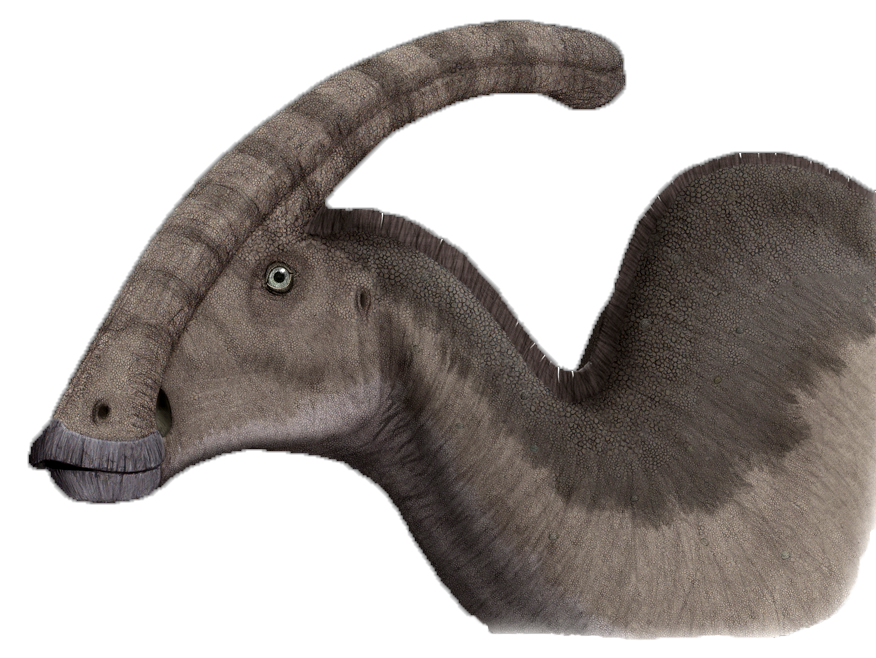
Parasaurolophus
The crested singer — a Late Cretaceous duck-billed dinosaur whose hollow tube-crest functioned as a built-in resonating wind instrument.
Range: North America
Description
Parasaurolophus, meaning "near crested lizard," is one of the most recognisable lambeosaurine hadrosaurids. It is famous for the long, tubular crest that curves backward from its skull. Paleontologists universally recognise three species: P. walkeri, the type species found with a long, curved crest; P. tubicen, a longer-crested variety from New Mexico; and P. cyrtocristatus, which had a smaller, more strongly recurved crest [5]. A potential fourth species from China, P. jiayinensis, is typically assigned to the genus Charonosaurus [2].
This large herbivore reached up to 9.5 m in length and possessed the standard hadrosaurid anatomy: a duck-billed skull, complex dental batteries, fleshy cheeks, and the ability to move on either two or four legs. Its most distinctive trait was its hollow crest, formed by elongated nasal bones and connected to its nasal passages. CT scans of P. tubicen (Sullivan & Williamson 1999; Diegert & Williamson 1998) have revealed a complex internal structure of folded tubes. This arrangement functioned much like a built-in trombone or other wind instrument.
Fossilized skin impressions show that Parasaurolophus was covered in small polygonal scales, potentially with longer scutes running along its spine. The crests grew as the animal aged. Juveniles had very short crests that lengthened as they reached maturity, making them a useful marker for identifying different growth stages.
Behaviour & ecology
Researchers have established several likely functions for the dinosaur's crest. Acoustic resonance is well-supported by studies such as Weishampel (1981). Biomechanical models show the hollow tubes could produce low-frequency calls, around a 30 Hz fundamental, which would carry across long distances. The distinct shapes of the crests among species also suggest they served for species recognition. Additionally, the crests probably functioned as display structures, possibly enhanced by vibrant colour patterns for sexual selection. While earlier theories suggested thermoregulation, this view has lost support in recent years.
Parasaurolophus inhabited coastal floodplains, living in herds alongside other hadrosaurids, ankylosaurs, ceratopsians, and large predators like tyrannosaurids.
Notable specimens
- P. walkeri holotype (ROM 768) — Royal Ontario Museum.
- P. tubicen holotype (PMU R1250) — most-CT-scanned crest specimen.
- P. cyrtocristatus holotype (FMNH P 27393) — Field Museum [5].
- Multiple growth-series specimens from various Laramidian formations.
Scientific debates
In popular culture
Parasaurolophus is one of the most-recognisable hadrosaurs in popular culture. Walking with Dinosaurs (1999) features it calling with the resonator-tube crest. Jurassic Park (1993) shows a herd in the iconic "they do move in herds" scene. Disney's Dinosaur (2000) features a Parasaurolophus as a supporting character.
Further reading
- Sullivan, R. M., & Williamson, T. E. (1999). A new skull of Parasaurolophus from the Kirtland Formation of New Mexico and a revision of the genus. New Mexico Museum of Natural History and Science Bulletin, 15.
- Weishampel, D. B. (1981). Acoustic analyses of potential vocalization in lambeosaurine dinosaurs. Paleobiology, 7, 252–261.
- Diegert, C. F., & Williamson, T. E. (1998). A digital acoustic model of the lambeosaurine hadrosaur Parasaurolophus tubicen. Journal of Vertebrate Paleontology, 18, 38A.
- Evans, D. C., et al. (2009). A juvenile Parasaurolophus (Ornithischia: Hadrosauridae) braincase from the Kaiparowits Formation. Journal of Vertebrate Paleontology, 29, 1080–1087.
Image gallery
Specimens, fossils, and reconstructions. License and attribution shown on every plate.
skeleton · 4 images


fossil · 2 images


life restoration · 4 images
 life restoration
 life restoration
 life restoration
 life restoration
anatomy · 1 images
 anatomy


.jpg)


Scientific literature
Peer-reviewed papers cited in this profile, drawn from OpenAlex and Crossref. Open-access PDFs flagged where available.
The Maastrichtian (Late Cretaceous) lambeosaurine dinosaur Charonosaurus jiayinensis from north-eastern China
Pascal Godefroit, Shuqin Zan, Liyong Jin · Bulletin De L Institut Royal Des Sciences Naturelles De Belgique-sciences De La Terre
Since the beginning of the 20th century, the Yuliangze Formation of the Jiayin locality, in north-eastern China, has yielded abundant dinosaur material. Palynological data suggest that the Yuliangze Formation is late Maastrichtian (Late Cretaceous) in age. About 90 percent of the bones recovered from this locality belo…
Charonosaurus jiayinensis n.g., n.sp.,a lambeosaurine dinosaur from the Late Maastrichtian of northeastern China
Pascal Godefroit, Shuqin Zan, Liyong Jin · Comptes Rendus de l Académie des Sciences - Series IIA - Earth and Planetary Science
A juvenile<i>Parasaurolophus</i>(Ornithischia: Hadrosauridae) Braincase from Dinosaur Provincial Park, Alberta, with comments on crest ontogeny in the genus
David C. Evans, Robert R. Reisz, Kevin Dupuis · Journal of Vertebrate Paleontology
ABSTRACT An incomplete braincase of a juvenile lambeosaurine hadrosaurid (Dinosauria: Ornithischia) is recognized as the second and smallest cranial specimen of Parasaurolophus from the Belly River Group (Campanian), Alberta, Canada. This specimen provides the first information on the ontogeny of the skull roof and aut…
A new species of hadrosaurian dinosaur from the Cretaceous of New Mexico
John H. Ostrom · Journal of Paleontology
A new species of Parasaurolophus, P. cyrtocristatus, is recorded from the Fruitland formation of the San Juan basin, New Mexico.
Parasaurolophus cyrtocristatus, a crested hadrosaurian dinosaur from New Mexico
John H. Ostrom · Bulletin of Miscellaneous Information (Royal Gardens Kew)
(Uploaded by Plazi from the Biodiversity Heritage Library) No abstract provided.
3D model
Rendered from a third-party scan. The viewer loads on click so the page stays fast.
AllThingsSaurus · CC Attribution
Further reading
Curated books and field guides. Some links earn us a small Amazon commission — supports the library, never your price.
Bring Parasaurolophus home — a hand-painted figurine vetted by the library.
Shop Parasaurolophus figurine →Silhouette: Richard Rich · https://creativecommons.org/publicdomain/zero/1.0/ · PhyloPic