Stegosauria
The plated and spiked dinosaurs — Mesozoic herbivores whose dorsal armour, despite a hundred years of debate, remains one of paleontology's loveliest unsolved problems.
Range: Worldwide
Description
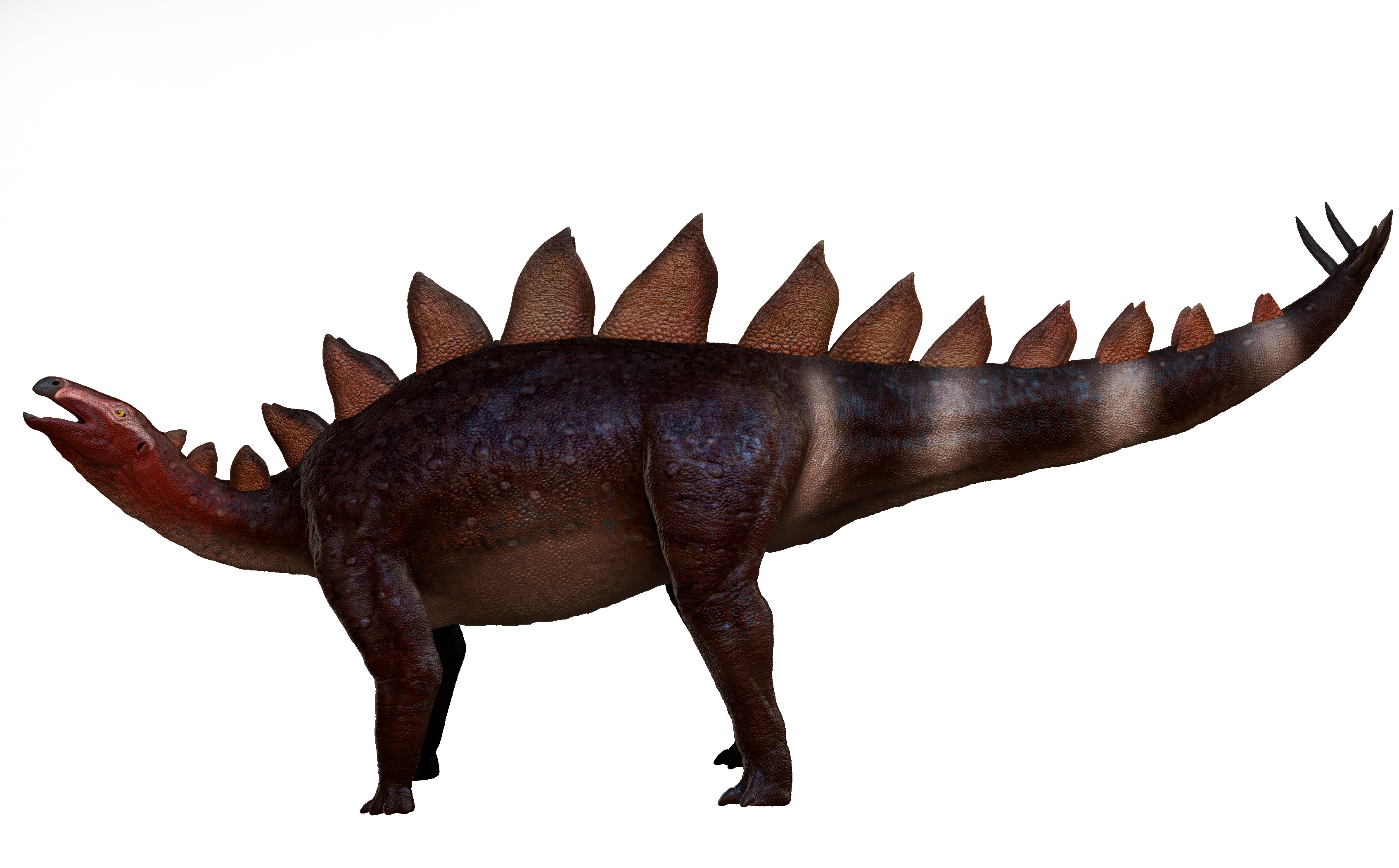
Stegosauria is one of the two primary subgroups of Thyreophora, the armoured ornithischians, with Ankylosauria being the other. They are defined by two parallel rows of dermal plates or spikes along their backs. These structures were supported by isolated dermal bone rather than being connected directly to the skeleton. Most members also possessed powerful tail armament. This cluster of spikes is informally known as a "thagomizer," a term coined in a 1982 Far Side cartoon and later adopted by the scientific community.
The stegosaurian body plan was notably asymmetric. Their hindlimbs were much longer than their forelimbs, resulting in a posture with a low front and high hips. They had small, narrow skulls and beaks, with leaf-shaped teeth limited to the rear of the jaw. Compared to the sauropods they lived alongside, stegosaurs were relatively small. The clade is divided into the basal Huayangosauridae, such as Huayangosaurus, and the more derived Stegosauridae, which includes Stegosaurus, Kentrosaurus, Tuojiangosaurus, Dacentrurus, Hesperosaurus, and Miragaia.
The shape of their plates varied significantly across species. Stegosaurus had large, kite-shaped plates, while Kentrosaurus possessed a mix of plates and long spikes. Tuojiangosaurus was primarily covered in spikes. One member, Miragaia, was unusual for its exceptionally long neck, which contained 17 cervical vertebrae.
Behaviour & ecology
Studies of plate histology (Main et al. 2005) reveal extensive vascularisation. This suggests the plates served for display or potentially for regulating body temperature. In contrast, the tail spikes were clearly used for defense. Fossils of Allosaurus have been found with wounds that match the shape of stegosaur spikes, including one famous specimen with a tail vertebra pierced by a thagomizer. Their high-backed, low-headed anatomy was well-suited for browsing on ferns, horsetails, and cycads near the ground.
In their ecosystems, stegosaurs were generally less common than sauropods. Their diversity declined sharply during the Early Cretaceous. The last known member of the group, Mongolostegus, lived during the Aptian–Albian ages.
Notable specimens
- Sophie (NHMUK PV R36730, Stegosaurus stenops) — Natural History Museum, London; most complete Stegosaurus.
- Dacentrurus armatus Holotype — multiple European specimens.
- Hesperosaurus mjosi holotype (HMNS 14) — Houston Museum of Natural Science.
- Mounted Kentrosaurus (MB.R.1934, MB.R.4800) — Museum für Naturkunde, Berlin.
Scientific debates
Plate function is the canonical stegosaurian debate: display, species recognition, thermoregulation, defence — all have advocates, and recent consensus favours display + possible secondary thermoregulation. Plate arrangement: Whether the plates were paired or alternating in life is settled (alternating, in Stegosaurus at least). Tail spike count and posture: the canonical four-spike thagomizer in Stegosaurus stenops is now well-supported. Body posture: whether stegosaurs could rear up bipedally to feed (Bakker 1986) is contested but mechanically plausible for Stegosaurus.
In popular culture
Stegosaurus's climactic battle with Allosaurus in Fantasia (1940) and a similar scene in King Kong (1933) made it a cinematic icon. It remains one of the four or five most-recognisable dinosaurs in popular culture.
Further reading
- Galton, P. M., & Upchurch, P. (2004). Stegosauria. In The Dinosauria (2nd ed.).
- Maidment, S. C. R. (2010). Stegosauria: a historical review of the body fossil record and phylogenetic relationships. Swiss Journal of Geosciences, 103, 199–210.
- Main, R. P., et al. (2005). The evolution and function of thyreophoran dinosaur scutes. Paleobiology, 31, 291–314.
- Carpenter, K. (ed.) (2001). The Armored Dinosaurs. Indiana University Press.
Image gallery
Specimens, fossils, and reconstructions. License and attribution shown on every plate.
skeleton · 3 images


fossil · 2 images
.gif)

life restoration · 3 images
 life restoration
.png) life restoration
life restoration.png) life restoration
life restorationanatomy · 1 images
 anatomy
size comparison · 1 images
 size comparison
other · 8 images
_from_the_Jurassic_of_the_Rocky_Mountains_Page_1.png) other
other_from_the_Jurassic_of_the_Rocky_Mountains_Page_2.png) other
other other
other other
other other
other other
other other
other other
otherScientific literature
Peer-reviewed papers cited in this profile, drawn from OpenAlex and Crossref. Open-access PDFs flagged where available.
Systematics and phylogeny of Stegosauria (Dinosauria: Ornithischia)
Susannah C. R. Maidment, David Norman, Paul M. Barrett · Journal of Systematic Palaeontology
Synopsis Stegosauria is a clade of ornithischian dinosaurs characterised by a bizarre array of dermal armour extending, in two parasagittal rows, from the cervical region to the end of the tail. Although Stegosaurus is one of the most familiar of all dinosaurs, little is known regarding the evolutionary history of this…
A new order of extinct Reptilia (Stegosauria) from the Jurassic of the Rocky Mountains
O. C. Marsh · American Journal of Science
The skull of the basal stegosaur <i>Huayangosaurus taibaii</i> and a cladistic diagnosis of stegosauria
Paul C. Sereno, Dong Zhimin · Journal of Vertebrate Paleontology
ABSTRACT The recent discovery of the Middle Jurassic stegosaur, Huayangosaurus taibaii has shed new light on the early phylogeny of Stegosauria. The skull of this taxon is described in detail and compared to those of other thyreophorans. Cranial and postcranial autapomorphies of Huayangosaurus include high premaxillary…
A new phylogeny of Stegosauria (Dinosauria, Ornithischia)
Thomas J. Raven, Susannah C. R. Maidment · Palaeontology
Abstract The stegosaurs are some of the most easily recognizable dinosaurs, but are surprisingly rare as fossils. Consequently much remains unknown about their palaeobiology, and every new stegosaurian find contributes to our understanding of the evolution of the clade. Since the last attempt to examine the evolutionar…
Stegosauria: a historical review of the body fossil record and phylogenetic relationships
Susannah C. R. Maidment · Swiss Journal of Geosciences
The first partial skeleton of a stegosaurian dinosaur was discovered in a brick pit in Swindon, UK in 1874. Since then, numerous stegosaurian remains have been discovered from Europe, North America, Africa and Asia, and continue to be discovered regularly. Stegosaurs are known from the Middle Jurassic to the Early Cret…
3D model
Rendered from a third-party scan. The viewer loads on click so the page stays fast.
wojciechmiedziocha · CC Attribution
Further reading
Curated books and field guides. Some links earn us a small Amazon commission — supports the library, never your price.
Silhouette: T. Michael Keesey · https://creativecommons.org/licenses/by-sa/3.0/ · PhyloPic