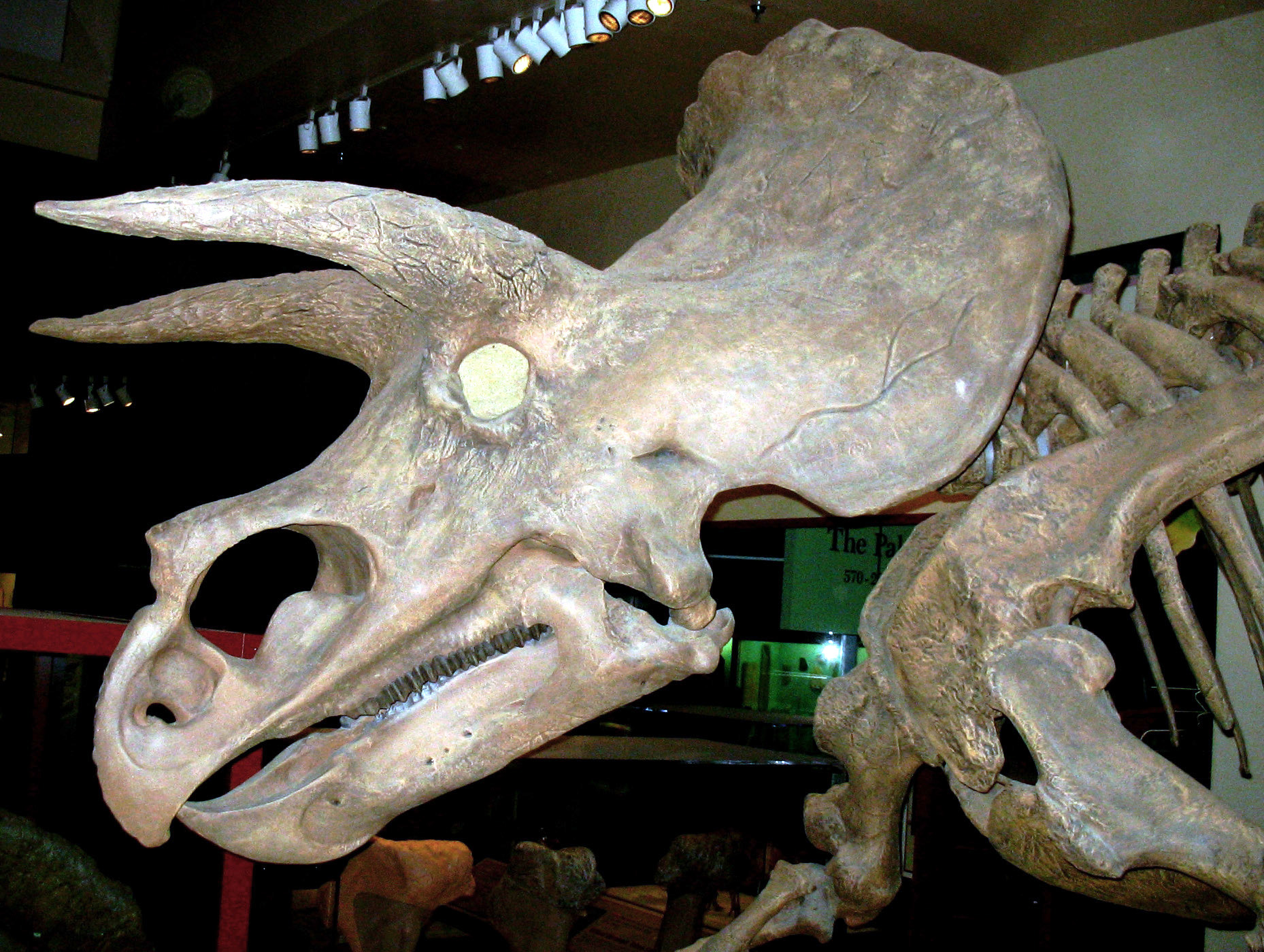
Triceratops
The three-horned face: the iconic ceratopsian, the apparent prey of choice for _Tyrannosaurus rex_, and one of the last non-avian dinosaurs to walk the Earth.
Range: Western North America (Hell Creek)
Popular Triceratops products
Sponsored — as an Amazon Associate, dinolibrary earns from qualifying purchases.
SCHLEICH DINOSAURS Triceratops 15050 — current product line, hand-painted
Shop Top Pick →SCHLEICH DINOSAURS Triceratops 15050 — current product line, hand-painted
Shop Kids' Pick →SCHLEICH DINOSAURS Triceratops 15050 — current product line, hand-painted
Shop Budget Pick →Description
Triceratops is the largest, last, and most-collected ceratopsian. Its defining features are the long postorbital brow horns (up to 1 m), a shorter nasal horn, and a solid (non-fenestrated) parietal-squamosal frill. That solid frill is what separates it from many of its centrosaurine and chasmosaurine relatives, whose frills had large windows. The skull alone could exceed 2.5 m, which puts it among the largest skulls of any land animal that has ever lived.
The body was massive and quadrupedal, with a barrel chest, short tail, and graviportal limbs. Skin impressions show large polygonal scales of varying size. Some workers (Bell et al. 2014) have argued for sparse bristle-like structures based on Psittacosaurus-like preserved integument in basal ceratopsians, but no direct Triceratops evidence confirms this.
Two species are universally accepted: T. horridus (older, typical of the lower Hell Creek) and T. prorsus (younger, typical of the upper Hell Creek) [5]. Scannella et al. (2014) found strong evidence that the first evolved anagenetically into the second through the Maastrichtian [2]. A third species, T. utahensis, is sometimes recognised.
Behaviour & ecology
Triceratops was the dominant herbivore of the latest Cretaceous Laramidian ecosystem. It coexisted with Tyrannosaurus rex, Edmontosaurus, Ankylosaurus, Pachycephalosaurus, and Thescelosaurus. Tooth-marked Triceratops bones, including a famous healed bite wound on a squamosal, confirm direct interaction with T. rex. Tooth wear suggests bulk feeding on fibrous low vegetation: palms, cycads, ferns.
The horns and frill probably did more than one job. Healed puncture and scraping wounds on adult skulls point to intraspecific combat, with animals locking horns in rutting-style fights like modern ungulates. Species recognition based on frill morphology also has good support. Thermoregulation through the frill is an older idea and less well supported. Herd behaviour is debated. Triceratops mass bonebeds are rarer than they are for centrosaurines, and many workers think the animal lived solitarily or in smaller groups [4].
Notable specimens
- Big John — largest known Triceratops, ~8 m skull length 2.62 m, sold at auction 2021, now in Glasgow.
- Lane (HRS08-1, Triceratops horridus) — Houston Museum of Natural Science; preserves skin impressions.
- YPM 1820 (Marsh's original holotype) — Yale Peabody Museum.
- Kelsey — well-preserved Hell Creek specimen, Black Hills Institute.
Scientific debates
Triceratops vs Torosaurus: Scannella & Horner (2010) proposed that Torosaurus is a fully mature Triceratops, which would sink the older genus [1]. Longrich & Field (2012) and most workers since rejected the synonymy on the basis of morphological gaps that the ontogenetic series doesn't bridge [3]. Anagenesis vs species pluralism: T. horridus → T. prorsus is a popular textbook example of anagenesis, though the boundary is somewhat fuzzy [2]. Combat vs display vs species recognition: all three are in play; the relative weight is the live argument.
In popular culture
The Triceratops vs T. rex matchup is the most-depicted dinosaur scene in popular culture, going back to Charles Knight's 1901 painting and forward through Jurassic Park. Triceratops is the state dinosaur of South Dakota and Wyoming.
Further reading
- Dodson, P. (1996). The Horned Dinosaurs. Princeton University Press.
- Scannella, J. B., & Horner, J. R. (2010). Torosaurus Marsh, 1891, is Triceratops Marsh, 1889. Journal of Vertebrate Paleontology, 30, 1157–1168.
- Longrich, N. R., & Field, D. J. (2012). Torosaurus is not Triceratops. PLOS ONE, 7, e32623.
- Scannella, J. B., et al. (2014). Evolutionary trends in Triceratops from the Hell Creek Formation. PNAS, 111, 10245–10250.
- Farke, A. A., et al. (2009). Evidence of combat in Triceratops. PLOS ONE, 4, e4252.
Image gallery
Specimens, fossils, and reconstructions. License and attribution shown on every plate.
skeleton · 6 images
 skeleton
 skeleton
 skeleton
 skeleton
 skeleton
 skeleton

anatomy · 6 images


Scientific literature
Peer-reviewed papers cited in this profile, drawn from OpenAlex and Crossref. Open-access PDFs flagged where available.
<i>Torosaurus</i>Marsh, 1891, is<i>Triceratops</i>Marsh, 1889 (Ceratopsidae: Chasmosaurinae): synonymy through ontogeny
John B. Scannella, John R. Horner · Journal of Vertebrate Paleontology
ABSTRACT Although they have been considered distinct genera for over a century, ontogenetic analyses reveal that Triceratops and “Torosaurus” actually represent growth stages of a single genus. Major changes in cranial morphology—including the opening of parietal fenestrae and the elongation of the squamosals—occur rap…
Evolutionary trends in<i>Triceratops</i>from the Hell Creek Formation, Montana
John B. Scannella, Denver W. Fowler, Mark B. Goodwin · Proceedings of the National Academy of Sciences
The placement of over 50 skulls of the well-known horned dinosaur Triceratops within a stratigraphic framework for the Upper Cretaceous Hell Creek Formation (HCF) of Montana reveals the evolutionary transformation of this genus. Specimens referable to the two recognized morphospecies of Triceratops, T. horridus and T. …
Is Torosaurus Triceratops? Geometric Morphometric Evidence of Late Maastrichtian Ceratopsid Dinosaurs
Leonardo Maiorino, Andrew A. Farke, Tassos Kotsakis · PLoS ONE
BACKGROUND: Recent assessments of morphological changes in the frill during ontogeny hypothesized that the late Maastrichtian horned dinosaur Torosaurus represents the "old adult" of Triceratops, although acceptance of this finding has been disputed on several lines of evidence. METHODOLOGY/PRINCIPAL FINDINGS: Examinin…
The first <i>Triceratops</i> bonebed and its implications for gregarious behavior
Joshua C. Mathews, Stephen L. Brusatte, Scott A. Williams · Journal of Vertebrate Paleontology
JOSHUA C. MATHEWS,1'2 STEPHEN L. BRUSATTE, '3 SCOTT A. WILLIAMS,2'4 and MICHAEL D. HENDERSON2 4; 1Department of Geography, Northern Illinois University, DeKalb, Illinois 60115-2825, USA, jmathewl@niu.edu; 2Burpee Museum of Natural History, 737 North Main Street, Rockford, Illinois 61103-6966, USA; 3Department of Earth …
<i>Triceratops</i>: an example of flawed systematics
John H. Ostrom, Peter Wellnhofer · Cambridge University Press eBooks
A total of 16 species have been named or referred to the genus Triceratops. Surprisingly, the genus has never been formally diagnosed until recently. The first named species, T. alticornus, is not demonstrably referrable to Triceratops. Accordingly, the second named species, T. horridus, is here designated the type spe…
3D model
Rendered from a third-party scan. The viewer loads on click so the page stays fast.
Zacxophone · CC0 Public Domain
Further reading
Curated books and field guides. Some links earn us a small Amazon commission — supports the library, never your price.
Bring Triceratops home — a hand-painted figurine vetted by the library.
Shop Triceratops figurine →Silhouette: Danny Anduza · https://creativecommons.org/publicdomain/zero/1.0/ · PhyloPic