Velociraptor
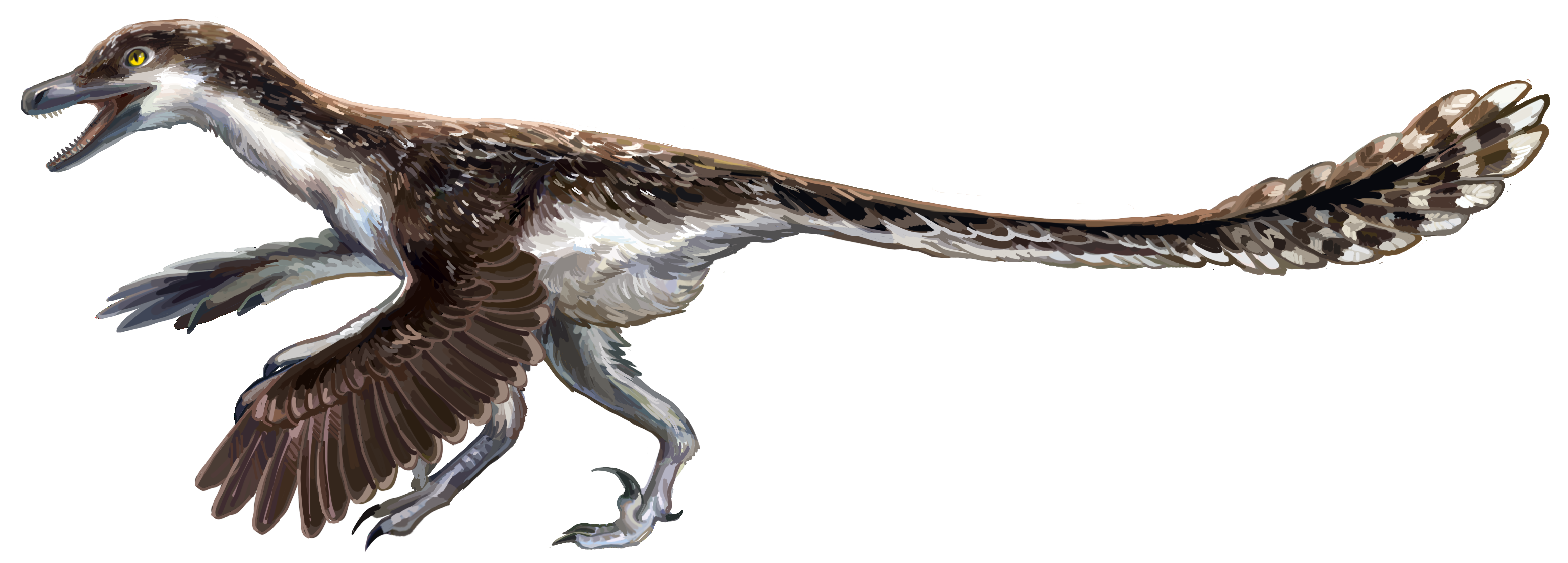
The "swift seizer": turkey-sized, fully feathered, sickle-clawed, and stamped permanently into popular culture by _Jurassic Park_'s scaled-up scaly version.
Range: Mongolia
Popular Velociraptor products
Sponsored — as an Amazon Associate, dinolibrary earns from qualifying purchases.
Schleich Dinosaurs 15045 Realistic Velociraptor — 18cm with movable jaw, ages 5+
Shop Top Pick →Schleich Dinosaurs 15045 Realistic Velociraptor — 18cm with movable jaw, ages 5+
Shop Kids' Pick →Schleich Dinosaurs 15045 Realistic Velociraptor — 18cm with movable jaw, ages 5+
Shop Budget Pick →Description
Velociraptor is one of the best-known dromaeosaurids. Henry Fairfield Osborn named it in 1924 from a remarkably preserved skull and forelimb collected on the AMNH expedition to Mongolia [1]. Two species are recognised today: V. mongoliensis (the type) and V. osmolskae, named in 2008 from skull material in the Chinese Bayan Mandahu Formation [2].
The animal was small, about the size of a turkey or a coyote, at roughly 2 m total length. Most of that length is a long, stiffened tail. The skull is long and low, with conical recurved teeth and a sharply upcurved snout that is autapomorphic for the genus [4]. The hand bears three long fingers tipped with curved claws. The foot carries the characteristic sickle claw on the second toe, held clear of the ground in life and rotated down for use.
Velociraptor was fully feathered. The most direct evidence is Turner et al. (2007), which described quill knobs (the bony attachment points for primary feathers) preserved on a Velociraptor ulna (IGM 100/981). Quill knobs are the same anatomical feature seen in many modern flying birds. Velociraptor itself was almost certainly flightless at this size, but its primary feathers were demonstrably pennaceous.
Behaviour & ecology
The most famous Velociraptor fossil is the Fighting Dinosaurs specimen (MPC-D 100/25): a Velociraptor and Protoceratops preserved locked in combat, with the Velociraptor's sickle claw embedded in the protoceratopsid's neck and the protoceratopsid's beak clamped onto the Velociraptor's arm. The pair was buried alive by a sand collapse during the fight roughly 75 mya. It is one of the most direct pieces of behavioural evidence ever found in a fossil.
Fowler et al. (2011) reinterpreted the sickle claw as a prey-restraint weapon, used to grapple and pin small to medium prey while the jaws and forelimbs did the killing. The model was drawn from modern raptors and seriemas, which use their talons in much the same way. The older "slashing blade" reading no longer has consensus.
Pack hunting in Velociraptor is contested. No clear bonebed exists, and most workers interpret Velociraptor as a solitary or loosely associated predator that took small prey: juvenile Protoceratops, mammals, lizards.
Notable specimens
- Fighting Dinosaurs (MPC-D 100/25) — Mongolian Academy of Sciences, Ulaanbaatar.
- AMNH 6515 — Osborn's holotype skull and forelimb, American Museum of Natural History.
- IGM 100/981 — Mongolian specimen with quill knobs preserved on the ulna (Turner et al. 2007).
Scientific debates
Sickle-claw function: current consensus is prey restraint, not slashing. Pack hunting: probably solitary or loose; no strong bonebed evidence. Species validity: V. osmolskae (2008) is widely accepted but comes from a different formation [2]; some workers suggest the differences may be partly preservational. Feathering extent: quill knobs prove pennaceous primaries, but full-body coverage is inferred.
In popular culture
Jurassic Park (1993) scaled Velociraptor up to Deinonychus size, stripped the feathers, and gave it doorknob-turning intelligence. The film's "raptor" became one of the most recognisable dinosaurs in cinema and displaced the real animal in public imagination. Jurassic World Dominion (2022) finally added feathers, decades late. Prehistoric Planet gets it right.
Further reading
- Norell, M. A., & Makovicky, P. J. (1999). Important features of the dromaeosaurid skeleton II: information from newly collected specimens of Velociraptor mongoliensis. American Museum Novitates, 3282, 1–45.
- Turner, A. H., et al. (2007). Feather quill knobs in the dinosaur Velociraptor. Science, 317, 1721.
- Fowler, D. W., et al. (2011). The predatory ecology of Deinonychus and the origin of flapping in birds. PLOS ONE, 6, e28964.
- Carpenter, K. (1998). Evidence of predatory behavior by carnivorous dinosaurs. Gaia, 15, 135–144.
Image gallery
Specimens, fossils, and reconstructions. License and attribution shown on every plate.
skeleton · 3 images


fossil · 2 images


life restoration · 1 images
 life restoration
anatomy · 4 images


.png)

size comparison · 1 images
![Size comparison between several individuals of the dromaeosaurid genus Velociraptor and a 1.8 m (5.9 ft) tall human. Specimens used in this diagram have been selected given their well-preserved skulls, which are fully referenced after Norell et al. 2006,[1] and Powers 2020.[2] References ↑ (2006). "A New Dromaeosaurid Theropod from Ukhaa Tolgod (Ömnögov, Mongolia)". American Museum Novitates: 1–51. DOI:[1:ANDTFU2.0.CO;2 10.1206/0003-0082(2006)3545[1:ANDTFU]2.0.CO;2]. ↑ The Evolution of Snout Sha](https://commons.wikimedia.org/wiki/File:Velociraptor_size.png) size comparison
size comparisonother · 8 images
 other
other other
other other
other other
other other
other other
other other
other other
otherScientific literature
Peer-reviewed papers cited in this profile, drawn from OpenAlex and Crossref. Open-access PDFs flagged where available.
A Theropod Dinosaur Embryo and the Affinities of the Flaming Cliffs Dinosaur Eggs
Mark A. Norell, James M. Clark, Dashzeveg Demberelyin · Science
An embryonic skeleton of a nonavian theropod dinosaur was found preserved in an egg from Upper Cretaceous rocks in the Gobi Desert of Mongolia. Cranial features identify the embryo as a member of Oviraptoridae. Two embryo-sized skulls of dromaeosaurids, similar to that of Velociraptor, were also recovered in the nest. …
A New Dromaeosaurid Theropod from Ukhaa Tolgod (Ömnögov, Mongolia)
Mark A. Norell, James M. Clark, Alan H. Turner · American Museum Novitates
We describe a new dromaeosaurid theropod from the Upper Cretaceous Djadokhta Formation of Ukhaa Tolgod, Mongolia. The new taxon, Tsaagan mangas, consists of a well-preserved skull and cervical series. This specimen marks only the second dromaeosaurid taxon from a formation that has otherwise yielded numerous specimens …
The skull of Velociraptor [Theropoda] from the Late Cretaceous of Mongolia
Ринчен Барсболд, Halszka Osmólska · Acta Palaeontologica Polonica
The well preserved material of the Late Cretaceous dromaeosaurid, Velociraptor mongoliensis, has allowed us to supplement earlier descriptions of the skull in this species. The skull of I? mongoliensis is similar to that of Deinonychus antirrhopus, but differs from the latter by: (1) laterally convex supratemporal arca…
The evolution of cranial form and function in theropod dinosaurs: insights from geometric morphometrics
Stephen L. Brusatte, Manabu Sakamoto, Shaena Montanari · Journal of Evolutionary Biology
Theropod dinosaurs, an iconic clade of fossil species including Tyrannosaurus and Velociraptor, developed a great diversity of body size, skull form and feeding habits over their 160+ million year evolutionary history. Here, we utilize geometric morphometrics to study broad patterns in theropod skull shape variation an…
A Velociraptor wishbone
Mark A. Norell, Peter J. Makovicky, James M. Clark · Nature
3D model
Rendered from a third-party scan. The viewer loads on click so the page stays fast.
cenkerturhan1 · CC Attribution
Further reading
Curated books and field guides. Some links earn us a small Amazon commission — supports the library, never your price.
Bring Velociraptor home — a hand-painted figurine vetted by the library.
Shop Velociraptor figurine →Silhouette: Richard Rich · https://creativecommons.org/publicdomain/zero/1.0/ · PhyloPic